
Competition, Opportunity Behind UPS $1B Euro Investment
UPS’ decision to invest $1B in Euro operations was based on Germany’s surging economy, growth in healthcare spending and competitors’ logistical build-out.
UPS’ decision to invest $1B in Euro operations was based on Germany’s surging economy, growth in healthcare spending and competitors’ logistical build-out.

Merchants who want to conduct cross-border ecommerce into France and Germany have to grapple with a common issue – trust in the online channel.

Beginning with Off Broadway Shoes’ social media presence, social media marketing agency redpepper generated brand engagement through a custom Facebook tab that housed “Sparkle Spree,” an interactive game with paired with a sweepstakes full of giveaways and prizes for participants.

Last holiday season, online retailers focused on streamlining the shopping experience so consumers could more easily find what they were looking for. So how can retailers build on this momentum? By taking the customer relationship one step further and getting inside the customer’s inner circle of trust as one of their “best friend brands.”

As operations and fulfillment technology continues to evolve, merchants face a decision of implementing a warehouse management system (WMS), a warehouse control system (WCS) or both.

In the never-ending decision over build vs. buy when it comes to software applications, a growing group of pure-play ecommerce providers is opting to develop their own homegrown warehouse management system (WMS), opting for the flexibility on upgrades and functionality over the comfort of relying on a vendor.
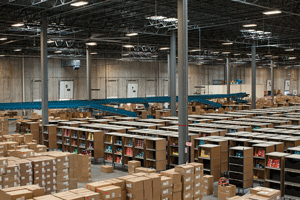
As distribution center operations continually look to streamline operations and gain efficiencies, a labor management system inevitably becomes part of the conversation. So the question becomes: when does investment in an LMS make sense for my operations? And what are the main criteria to consider in making this important decision?

How are you handling retail inventory management? Your answer to this critical question can lead to increases in your top and bottom line – or added costs if your inventory is bloated, hard to access or poorly allocated.

ProShip, Inc., a provider of multi-carrier shipping software and distribution systems, was recently the first company to become certified as a DHL Global Mail International Solution provider. Here’s what the partnership means for ProShip’s global customers.

Endicia CEO Amine Khechfé shares some more best practices for making returns of items purchased online easier for consumers.